
Agentic CommerceGenPark Personal AgentAI Shopping AgentRetail TechAmazon AlexaMachine LegibilityGEOSovereign AI
The Agent Blockade: Why Retailers Are Banning Shopping Bots While Amazon Injects Ads
by GenPark2026-11-13
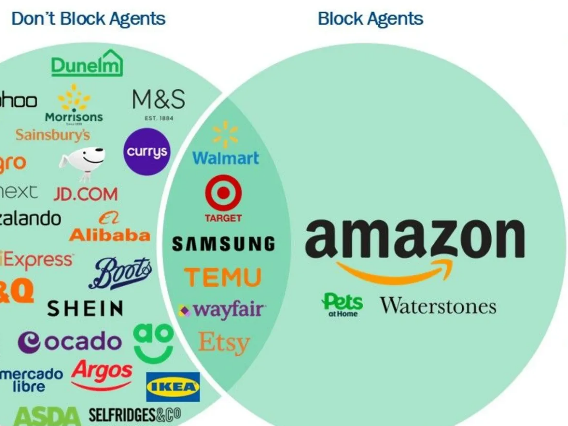
As retailers ban automated shopping bots and Amazon injects sponsored ads into text shopping agents, the battle for consumer trust is heating up. Here is why sovereign personal agents and structured legibility will win.
The Agent Blockade: Why Retailers Are Banning Shopping Bots While Amazon Injects Ads
November 2026 has become the defining flashpoint for the future of retail.
Over the past two weeks, two conflicting headlines revealed the deep tension at the heart of agentic commerce. On one front, major consumer retailers and travel providers began deploying aggressive firewalls to block automated AI shopping bots and headless browsing agents. Their stated fear is the loss of direct human touchpoints, screen ownership, and ad impression revenue.
On the other front, Amazon expanded text-based conversational shopping for Alexa, allowing shoppers to message requests and reorder items directly through SMS. Yet within days of launch, testing revealed that Amazon had begun weaving Sponsored Product ads directly into the agent recommendations. A shopper asking for an objective recommendation is once again served the highest bidder.
These two events highlight a fundamental truth about the next era of digital commerce: the battle is no longer about whether AI can shop. It is about who the AI is actually working for.
The structural conflict of the merchant bot
When a dominant retail platform launches an AI shopping assistant, it faces an irreconcilable conflict of interest. The company profits from two opposing activities: serving the shopper with honest utility, and charging merchants for sponsored placements and priority visibility.
When an AI assistant is subsidized by an advertising auction, its recommendations cease to be objective reasoning. If you text an assistant asking for the most reliable cordless vacuum for pet hair under $250, and the first recommendation is a sponsored tier from a conglomerate that bid the most per query, the assistant is not an agent. It is a digital billboard in dialogue form.
This is why platform-owned shopping bots will struggle to earn long-term consumer trust. Consumers do not want a salesperson in their messaging inbox. They want an adversarial advocate on their side of the table.
The futility of the retailer blockade
At the opposite end of the spectrum, traditional retailers attempting to ban shopping agents are fighting a losing battle against consumer convenience. Blocking agents out of fear of losing website ad impressions repeats the exact mistake newspapers made when they attempted to block search engines in the early 2000s.
Shoppers are not using agents to harm merchants. They are using agents because the traditional retail web has become unbearable. An ordinary purchase today requires dodging newsletter popups, navigating deceptive countdown clocks, auditing historical price markups, and parsing dozens of near-identical affiliate gift guides.
A personal agent removes that friction. When a retailer blocks an agent, the consumer does not suddenly decide to spend two hours manually browsing that retailer's catalog. Instead, the consumer simply asks their agent to reroute the purchase to an open storefront that welcomes automated discovery.
The 57 percent reliability wall
The rush to deploy shopping agents has also exposed a technical reality. A benchmark study published by Visa in November 2026 tested 22 consumer AI agents across common multi-step shopping tasks, revealing an average success rate of roughly 57 percent.
Why do current shopping agents fail nearly half the time? Because they are forced to scrape brittle, human-facing websites filled with dynamic JavaScript, unstandardized size selectors, and hidden inventory states. Forcing an AI model to visually decipher a chaotic web page using cloud browser simulation is expensive, slow, and prone to hallucinations.
This failure rate confirms what GenPark has argued since our inception: the breakthrough in agentic commerce will not come from building bigger screen-scraping bots. It will come from creating a clean, structured layer of machine legibility.
From web scraping to structured legibility
For independent merchants and emerging brands, the winning strategy during this holiday season is neither blocking agents nor paying for in-chat sponsored ads. The winning strategy is Generative Engine Optimization (GEO) through structured, verifiable product information.
When a brand publishes clear, deterministic product specifications, verified dimensional limits, transparent warranty terms, and honest return policies, an AI agent can evaluate that product in milliseconds without scraping errors. In an era where 43 percent of agent web actions break, being computationally legible is the ultimate distribution moat.
Where GenPark fits
GenPark Personal Agent is built on the principle of consumer sovereignty and objective reasoning.
First, GenPark Personal Agent never accepts sponsored product placements or paid ranking auctions. Its reasoning is bound strictly to the user's objective function: your living space, your noise tolerance, your aesthetic preferences, and your real budget.
Second, GenPark does not treat shopping as a black-box auto-checkout trick. It functions as an interactive decision workspace. It organizes products into structured cards that clearly display official specifications alongside real-world trade-offs, helping you make informed decisions with high confidence.
Third, GenPark provides emerging brands with a direct path to machine legibility. By structuring product data into rich, multi-angle contexts that answer engines can instantly parse and verify, GenPark bridges the gap between honest makers and high-intent consumers.
The retail web is splitting into two worlds. In one world, legacy gatekeepers erect walls and inject ads into private conversations. In the other world, sovereign personal agents and legible brands collaborate to make commerce efficient, honest, and effortless.
Try GenPark Personal Agent
Experience research-driven, ad-free product discovery. Tell GenPark what you need, your exact constraints, and what matters most at https://genpark.ai/agent.
Sources
GeekWire and Digiday coverage on Amazon's text-based Alexa shopping assistant and in-message sponsored products testing (November 2026).
Visa Economic and AI Research Group: Performance Benchmark of 22 Consumer AI Shopping Agents across Multi-Step Workflows (November 2026).
Business Insider reports on retail and airline automated agent blocks and bot mitigation firewalls (November 2026).
GenPark Personal Agent: https://genpark.ai/agent
Frequently asked questions
Why are retailers trying to block AI shopping agents?
Retailers fear losing direct consumer touchpoints, website ad impression revenue, and the ability to steer buyers with promotional banners. However, blocking agents often drives shoppers to more accessible competitors.
What is wrong with sponsored ads inside AI shopping agents?
When an AI agent is paid to recommend specific products, it stops acting as an objective advisor for the buyer. Sponsored placements introduce conflict of interest, making it difficult for consumers to trust recommendations.
Why do current shopping agents have a 57 percent failure rate?
Most agents rely on scraping human-facing websites, which are prone to shifting layouts, unexpected popups, and unstructured data. Without standardized machine-readable schemas, automated workflows frequently break.
How does GenPark Personal Agent differ from platform shopping assistants?
GenPark Personal Agent does not sell sponsored placements, push affiliated products, or force automated checkout. It acts as an independent decision workspace that evaluates options based strictly on your individual constraints.